
Copperhead
“Serpent Wisdom I propose, is the wisdom of feeling directly, as the Serpent feels vibrations in the Earth. The Serpent is wise in that it lives in immediacy, without need for elaborate intellectual frameworks Humankind is endlessly constructing for itself. For what in us is belief and faith, in other creatures is inborn knowledge…As for the Serpent, who can tell where it’s head and body begins? It experiences God in all parts of itself, it feels the vibrations of Divinity that run through the Earth, and responds to them quicker than thought.”
- Margaret Atwood, MaddAddam
“I become the earth I set my ear against, for rumors of the future.” - Margaret Atwood
I’ve been thinking about snakes a lot lately. My youngest nephew Max has recently become fascinated by snakes and frequently expresses his desire to go snake hunting with me. He tells me with complete earnestness that he doesn’t want to hurt the snakes. Max just wants to be where the snakes are. Me, too Max.
Snakes have always been a totem animal for me. They are constantly shedding old skin, reinventing themselves, letting go of boundaries that feel too small. And, the way they perceive the world is incredible. Snakes lack external ears or ear drums. As they move along the ground, they use their jaw bone to conduct vibrations up into an inner ear. They listen directly to the Earth without intermediary. These days, I’m trying to do the same.
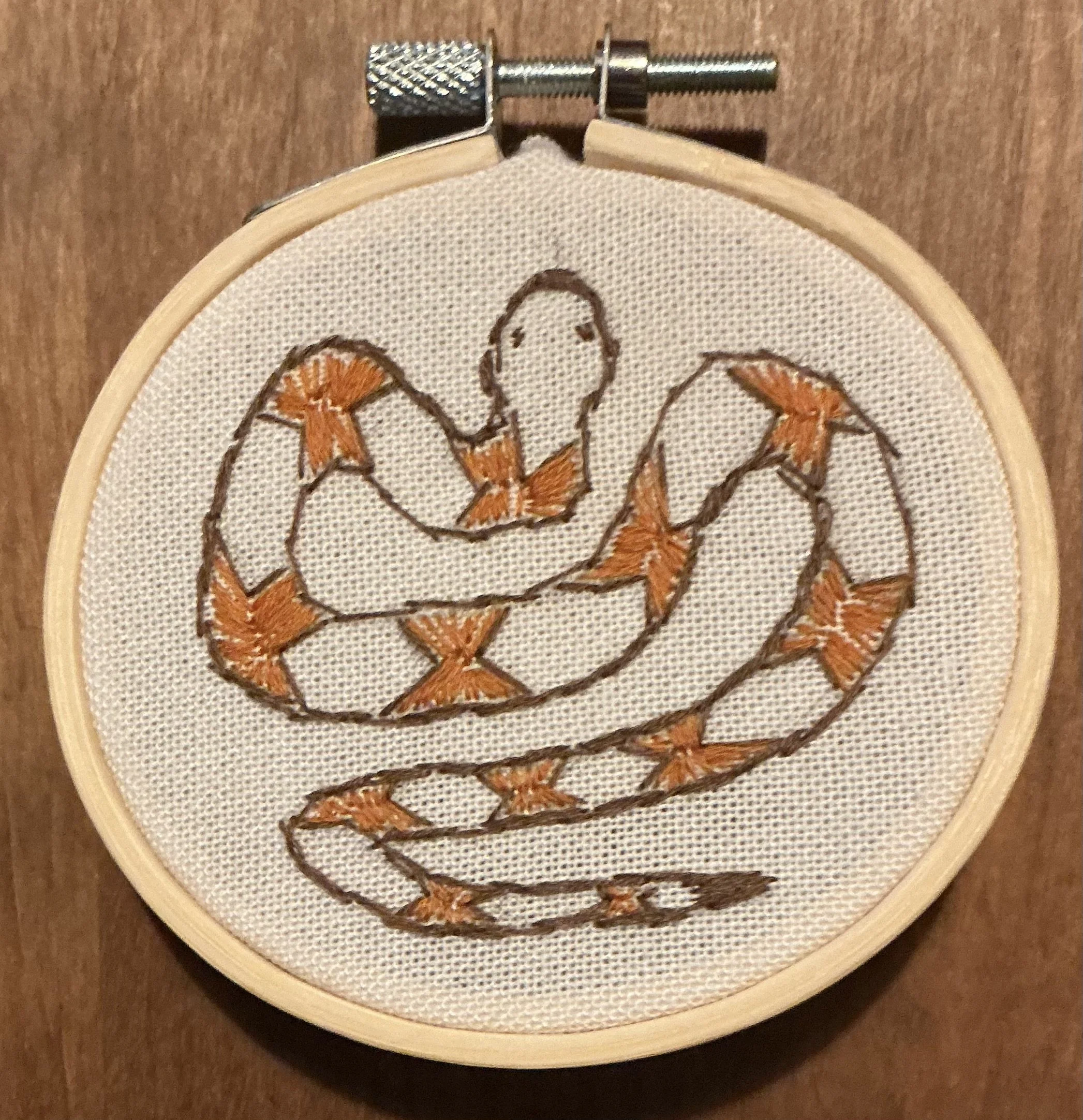
One of my favorite Kentucky snakes is the much maligned Copperhead. While it is true that Copperheads are responsible for the majority of venomous snake bites in the US, Copperheads are extremely docile and will typically bite only when directly stepped on. That’s more than I can say for most humans. The issue lies with their impeccable camouflage- a lovely melange of browns, creams, coppers and pinks. Add their characteristic chestnut hourglass banding and they become nearly impossible to spy in leaf litter. This isn’t to say they don’t try to warn us. Copperheads have an array of tactics they employ to avoid biting humans. They will vibrate their tails in warning and musk, mouth gape, or curl into a small pile and freeze, all hoping to avoid wasting their venom on a massive beast they couldn’t possibly eat. Copperheads will also frequently, more than any other pit viper, deliver a dry bite first. For all these reasons, one could say that bites owe more to simple human heedlessness than to any aggression on the part of the Copperhead.
Copperheads invite us into a different state of awareness. They ask us to move slowly, gently, respectfully through forests. They ask us to pay attention. When I’m in an area where I’ve seen Copperheads before, my whole demeanor changes. I slow down. I step gently. I look at what I’m seeing. And when I do find a Copperhead, I’m mesmerized. Seeing one in the wild, there’s always a thrill of adrenaline followed by a wave of gratitude that I haven’t just stepped on the poor creature. Then, as my heart rate slows, as we each take in the other, I begin to feel Copperhead energy. Each Copperhead I have ever met has been a study of elegantly restrained power, like a stick of dynamite wrapped in velvet. I take a moment to breathe, nod my deference and thankfulness for their clemency, then quietly take my leave.

September is a particularly auspicious month for a chance encounter with this reptile. Beginning in mid-August and continuing through mid-October, Copperhead mothers begin to deliver their young via live birth. In the truest sense of the phrase, female Copperheads are a force of nature. They will often challenge potential mates to wrestle and will refuse courtship with any male who backs down. After mating, females are capable of storing sperm for up to a year, waiting for the correct timing of their pregnancy to occur. Incredibly, if necessary, they can also switch from sexual to asexual reproduction and produce offspring via parthenogenesis, a reproduction method in which an unfertilized egg divides, grows, and develops into an embryo, all without sperm. When born, juvenile Copperheads have tails tipped in an electric yellow-green. While the standard camouflage hides the rest of their body, these tail tips look strikingly similar to caterpillars, and are used as lures for hapless frogs and lizards, drawing easy prey to the young snake.
As they grow, Copperheads have an extremely varied diet and will consume anything from spiders and millipedes, to birds, bats, turtles, and even carrion. Copperheads are typically ambush predators, relying on their excellent camouflage as they lay in wait. For their favorite meal, Copperheads will actually go hunting, and have been observed climbing as high as 40 feet into trees in pursuit of emerging cicadas which contain more protein than rodents. When given the chance, of course, Copperheads will happily consume small mammals such as mice and rats, and by proxy, all their accompanying ticks. If nothing else, humans should be aware of and grateful that Copperheads destroy a significant quantity of ticks in Eastern forests. It’s thought that, like Timber Rattlers who have similar diets, each Copperhead eats 2500-4500 ticks annually. As our planet warms, tick counts and accompanying illnesses such as Lyme, Alpha-Gal, and Rocky Mountain Spotted Fever, are on the rise. I’m tempted here, to tell you to protect Copperheads so we can reduce tick-born illnesses. I’m tempted to tell you all about current research in animal trials showing that their venom can halt cancer growth and migration. I’m tempted to keep spilling facts about how interesting and unusual these gorgeous snakes are. I want to convince you that Copperheads are beautiful and unique and fascinating. But the truth is, that Copperheads are worthy of your respect, regardless of what they can do for humans. Copperheads belong in the web of life and have a right to be here as much as any other being. When we show preference for any being above another (ourselves very much included), we shred the web of life, and in doing so, cause unforeseen, irreparable damage.
This September, as you enter the forests to hike, move slowly and respectfully, with Copperhead awareness. As you walk, listen, you may start to hear the vibrations of the Earth.
Resources:
Eastern copperhead. (2023). In Wikipedia. https://en.wikipedia.org/wiki/Eastern_copperhead
RWS Staff. (2024, June 29). Critter Corner: It’s Ssssssummer! Rockfish Wildlife Sanctuary Blog. https://rockfishwildlifesanctuary.org/2024/06/29/critter-corner-happy-ssssssummer/
Szalay, J. (2014). Copperhead Snakes: Facts, Bites & Babies. In Live Science. Live Science. https://www.livescience.com/43641-copperhead-snake.html
