
Monarch
““O snail/ Climb Mt. Fuji/ But slowly, slowly!”
- Kobayashi Issa
“Do you know the origin of that word saunter? It's a beautiful word. Away back in the middle ages people used to go on pilgrimages to the Holy Land, and when people in the villages through which they passed asked where they were going they would reply, 'A la sainte terre', 'To the Holy Land.' And so they became known as sainte-terre-ers or saunterers. Now these mountains are our Holy Land, and we ought to saunter through them reverently…”
- John Muir
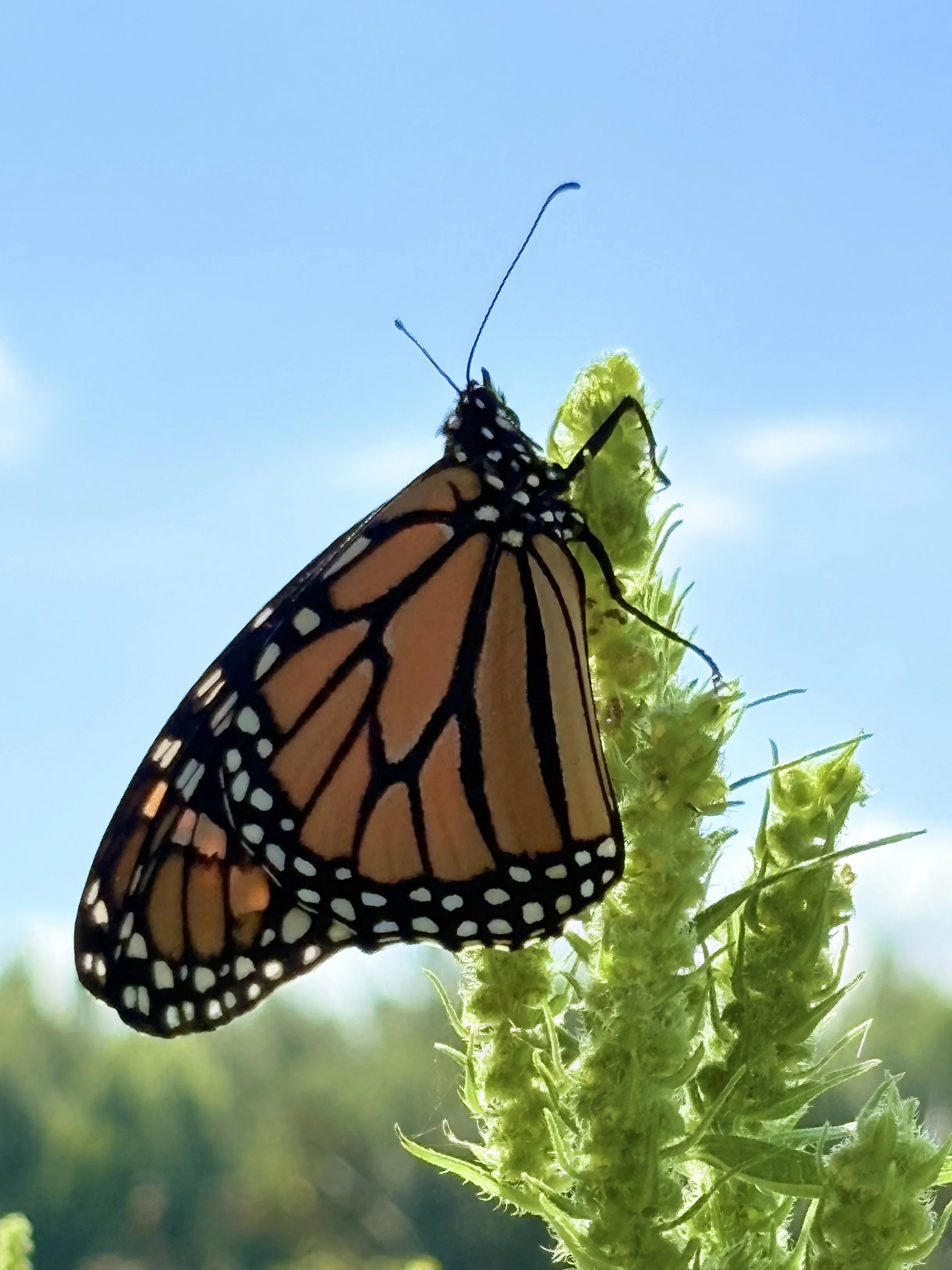
The monarchs are migrating this time of year, filling the air with occasional sparks of orange, like flying embers. When I’m very lucky, I catch one visiting the passionflowers on my porch- pure flame against the cool purple fringe of petals. Each time my heart catches in my throat, each beat hammering, “It is? Is it? Is it?” The monarch has so many mimics, I fumble in my excitement, throwing aside everything else, until I’m close enough to confirm that yes, this time it’s a monarch.
For the monarchs, my porch is a moment’s rest and nourishment on a 3,000 mile journey. For me, it’s something wholly different. In Hinduism, there is a term darshan, which is a form of blessing, the rare chance to see and be seen by a guru or holy individual. It’s not that the guru actively bestows a blessing, it’s that the mere act of being able to see them, to witness their presence, is in itself a blessing.
There is a long tradition that links travel with holiness. The Latin term peregrinātiō means a journey abroad and the link in Spanish is even more obvious- peregrino means pilgrim. This, by the way, is how the migratory peregrine falcon earned its name. Between the 6th and 10th centuries, there even existed a sect of Celtic Christian monks called the Peregrini. As a form of devotion, they wandered away from their home abby with the intention to never return. Many were on foot. Some set sail in small boats without oars, sails, or even a rudder in ultimate surrender to the will of God.
For me, the term peregrino has deep personal meaning. Many years ago I worked as a nurse in Honduras. The clinic I worked for, San Benito Jose, was run by a group of Franciscan friars, one of whom was Brother Gerard. It’s hard to describe Brother Gerard as anything but embodied joy. He was deeply humble, incredibly kind and soft spoken, an endearingly bumbly man, who seemed to be constantly beaming at everyone around him. His presence was a balm. My time in Honduras was extremely difficult as I encountered levels of poverty and violence far beyond any I had yet witnessed in my young life. Often I would rail to Brother Gerard- about our lack of supplies, about governmental corruption, about the need for better health education. In retrospect I see clearly that all my anger was the projection of a much deeper despair at my complete powerlessness to address the suffering around me. Brother Gerard would listen patiently and more often than not his response would be “somos peregrinos, Maria. Poco a poco vamos a llegar.” We are pilgrims, Mary, little by little we will arrive.
What I came to gradually learn was that anything worth doing takes a long time, and that the holiness, the value, is usually not in the destination itself. I’ve been extremely fortunate enough to make a few long pilgrimages myself- hikes of over 2,500 on the PCT and CDT. Both times, I came back completely destroyed and made anew, and it had nothing to do with the end goal, and everything to do with what happened along the way. I think of the monarchs, frequently traveling much further. I think of their brittle wings, sharp gusts of wind, swooping birds. I think of interstates and rushing cars, acres of Roundup sprayed fields, miles upon miles of hot asphalt blanketing what was, long ago, flower filled meadow. In a time when so many other species have had their ancient migratory paths shattered by habitat loss, by dams, by roads, by fences, by walls, that even one monarch makes the trip to Mexico is a miracle. To have one in my yard. Yes, a darshan.
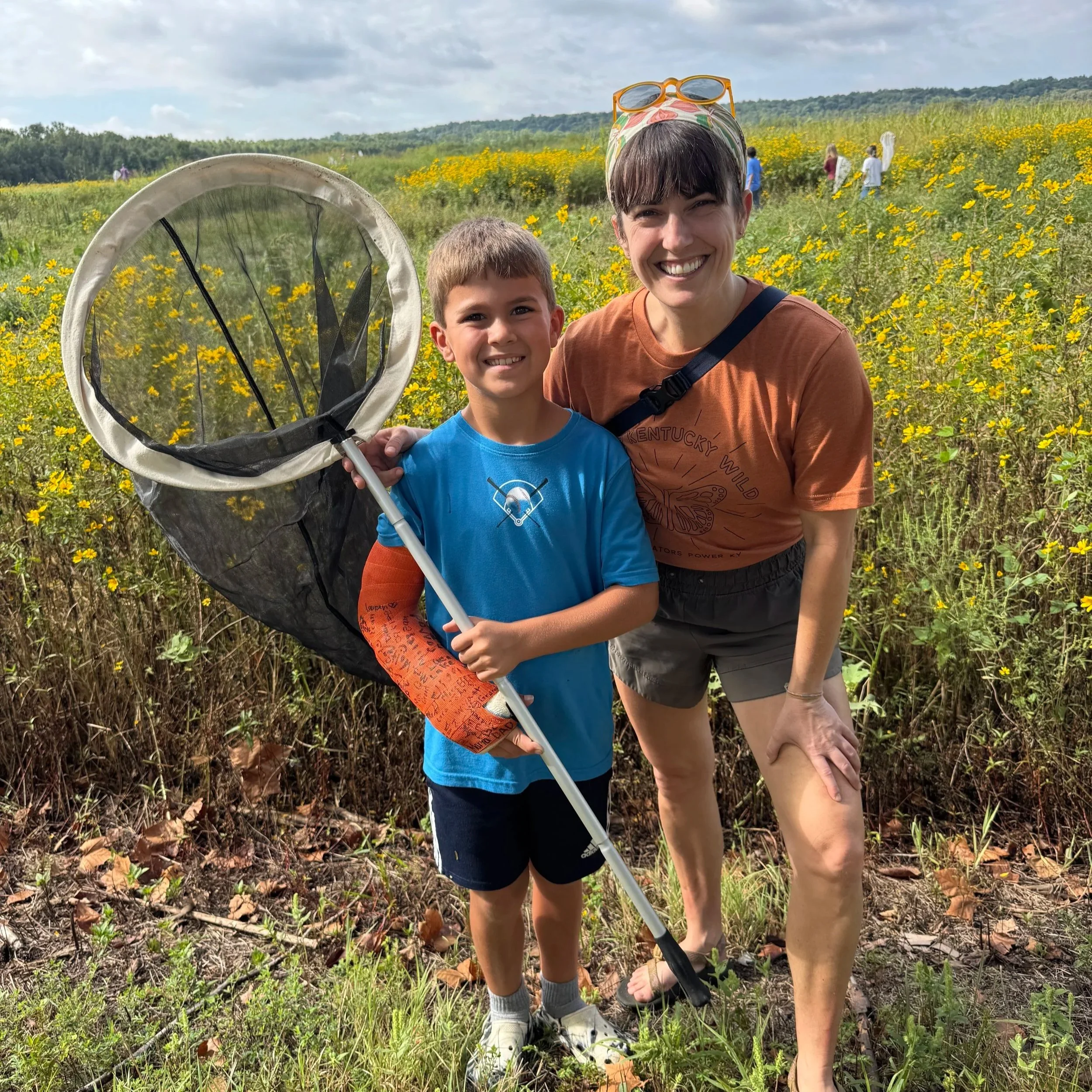
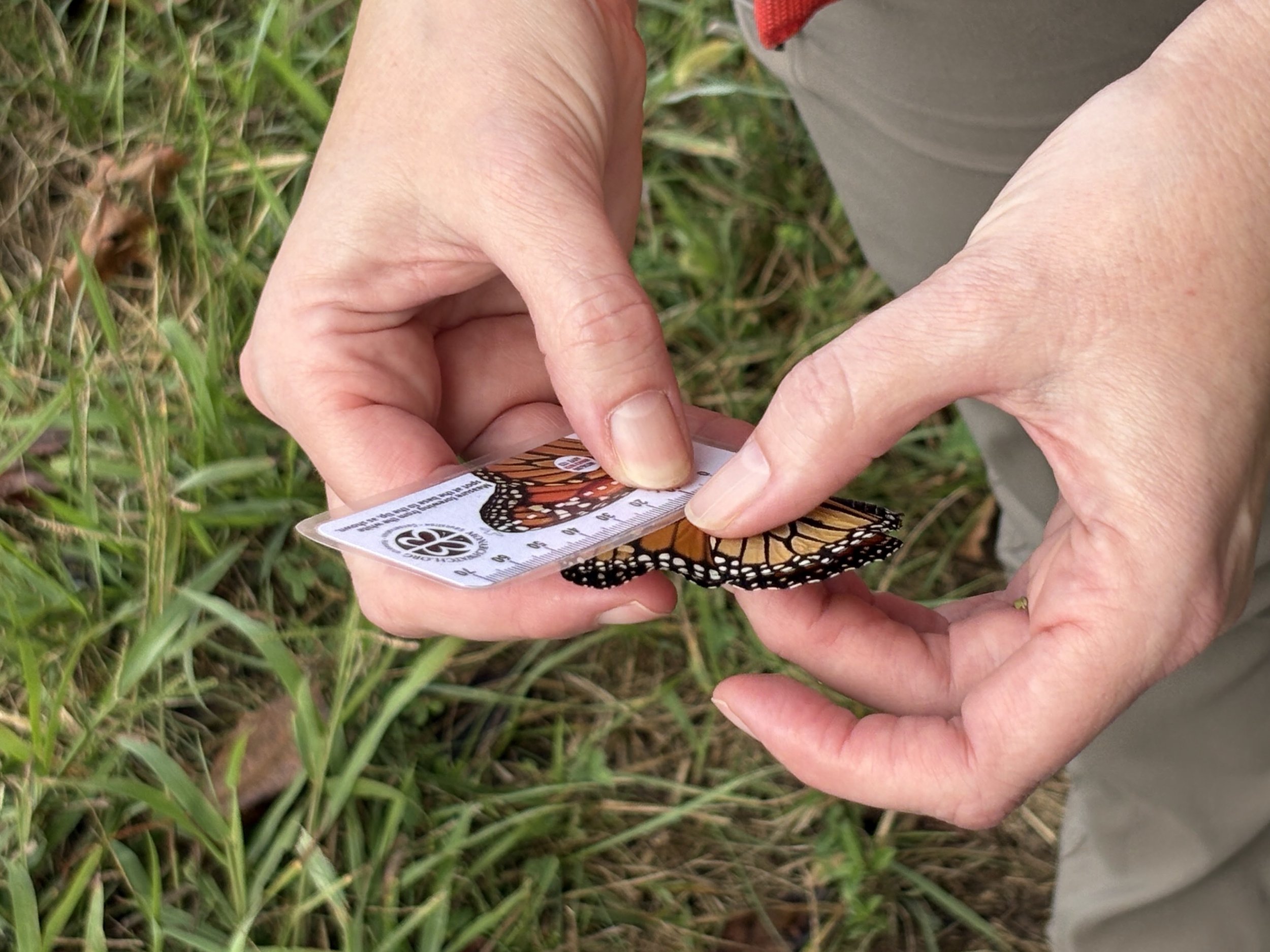
This year I was very fortunate to be able to take my 8 year-old nephew Max to a monarch tagging event. Max would be outfitted with a net, and along with several others, set loose on a bright field of yellow tickseed flowers. Participants able to net a monarch would take them to a trained facilitator who would note the butterfly’s sex and wingspan, then apply a tiny numbered sticker to their wing. Later this year, researchers in Mexico will seek out these stickers and track how many monarchs were able to make the trip. Scientists hope that data from tagging events like these will give them tools to help the monarchs survive.
Prior to the event, I spent some time chatting with Max, attempting to imbue him with some sense of wonder about the monarch’s journey. I told him that not all monarchs migrate, that it’s only the very last generation that is born each year, the so-called “Super generation” or “Methuselah generation,” that actually makes the trip down to their breeding grounds in Mexico. I told him that each new monarch in a super generation has never been to Mexico before, and yet, somehow, they find their way. Unfortunately it’s not easy to impress Max. He’s a sharp, confident kid and when it comes to nature, he usually knows the answer even if he doesn't know the answer. “It’s the warmness and the coldness. That’s how they know,” he explained. Duh. I just nodded and said “yeah, that could be it.” To be honest, Max’s explanation sounded way more plausible than what science currently believes which, when I looked it up, involved the phrases “time-compensated sun compass” and “light-dependent magnetic” cues.
When the day finally arrived, our adventure started out, to my chagrin, with a Power Point presentation. While I was eager to learn about the monarchs we were about to catch, I watched Max squirm and fiddle out of the corner of my eye. I didn’t think he had heard a single word until we walked out and he turned to ask, completely flabbergasted, “so those caterpillars make a chrysalis and they turn into a butterfly but in the middle they just turn into GOO?!” Yup. That’s exactly what the lady with the Powerpoint had said. Caterpillar. Goo. Butterfly. That got him. And me. We are living right in the midst of tiny insane miracles.
We spent the rest of the afternoon in that yellow-flecked field. Max, his recently broken arm swathed in a monarch orange cast, running full tilt after butterflies, wielding a net much larger than himself. I worried, in his sheer enthusiasm, that he would damage any butterfly he caught. But he was extremely gentle with the two he managed to net. And though they weren’t monarchs, this in no way dampened the utter joyfulness of our day. Sweaty and exhausted Max finally tumbled into my car for the drive home. We were in the middle of nowhere and searching for anything to fill our growling bellies when suddenly with delight Max yelled “taco truck!” I flipped around and took us right back to the white truck where we ordered two chicken quesadillas from the kind Mexican man behind the counter, and ate them hot at a picnic bench in the sun.
So much of our world is fragmented and suffering. There is so much work yet to be done. It will take us such a long time, generations even. Sometimes the devastation of our planet makes me feel like I am drowning. But for that one afternoon at least, I was able to slow to the pace of a pilgrim, one step, one butterfly at a time.
References
McCarthy, D. (2007, September 28). Hearts and minds aflame for christ: Irish monks—A model for making all things new in the 21st century. In Pursuit of Truth | A Journal of Christian Scholarship.https://www.cslewis.org/journal/hearts-and-minds-aflame-for-christ-irish-monks%E2%80%94a-model-for-making-all-things-new-in-the-21st-century/view-all/
Peregrination - wiktionary, the free dictionary. (2021). Wiktionary. https://en.wiktionary.org/wiki/peregrination
Wikipedia Contributors. (2019, April 7). Monarch butterfly. Wikipedia; Wikimedia Foundation. https://en.wikipedia.org/wiki/Monarch_butterfly
